 Values
Reference
Profiles
Exotics
Order
MENU
Values
Reference
Profiles
Exotics
Order
MENU

Despite not having a V8 engine in the early 1950's, Chevrolet almost consistently outsold its nearest rival, Ford, whose legendary flathead V8 seemingly would give it an edge in the marketplace. What Chevy did have was a tough and dependable six-cylinder engine that provided adequate power, good fuel economy and good reliability. The engine design, affectionately known as the "Stovebolt" six, was first introduced in 1929 and it won Chevrolet millions of sales. Though it had seen a number of improvements in the 24 year period up to 1953, it was still the same basic motor and hailed as one of the best engines ever to come out of Detroit.
| Minus | Plus |
|
Reasonably priced |
Probably has maxed out in value Sure could use a V8! |
By the 1953 model year, Chevrolet's six had grown to
235.5 cubic inches. For those Chevy's equipped with the standard
three-speed or overdrive transmissions, the compression ratio was
posted at 7:1 giving the car 108 horsepower at 3600 RPM. For Bel Airs
and 210 series that were equipped with the optional Power-Glide
automatic transmission, the six was given an increase in compression
to 7.5:1, which bumped the horsepower up to 115. (The new 150 Series
was not available with Power-Glide). In this same year the new
fiberglass bodied Corvette was also introduced. While it used the same
basic engine, Corvette's "Blue-Flame Six" was equipped with triple
carbs, a modified set of valve and timing ports and high performance
heads which boosted the compression ratio up to 8:1 and horsepower to
150 at 4200 RPM.
Even without a V8, Chevrolet did very well in holding on to its
number-one sales spot for the majority of the post-war model years.
Taking the cue that the "sizzle sells the steak", what Chevy lacked in
the engine bay, it made up with styling and, of course, chrome. 1953
represented the second major post-war styling change for Chevrolet.
While Ford and Plymouth had gone to nearly slab-sided bodies,
Chevrolet retained the look of separate rear fenders, even if they
were an integral part of the body shell.
Chevrolet's front end styling in 1953 was bold and laden with chrome.
The grille featured a strong horizontal chrome bar with three vertical
fins, capped at each end with circular turn signal-parking light
housings. All of this was framed by a bridge of die-cast chrome on top
and a strong rounded bumper along the leading lower edge. Finishing
off the frontal theme were the chrome plated headlight doors and Chevy
shield logo framed by even more chrome. This same front end styling
was used on all three series that year.
Color was also very important to General Motors marketing in 1953, and
the Chevrolet was about as colorful as it could be. A total of
thirteen single-tone hues were available, with eleven two-tone
combinations listed. Each series had several interior trim choices
that could be color-keyed to the exterior.
 1953 Bel Air 2dr Hardtop
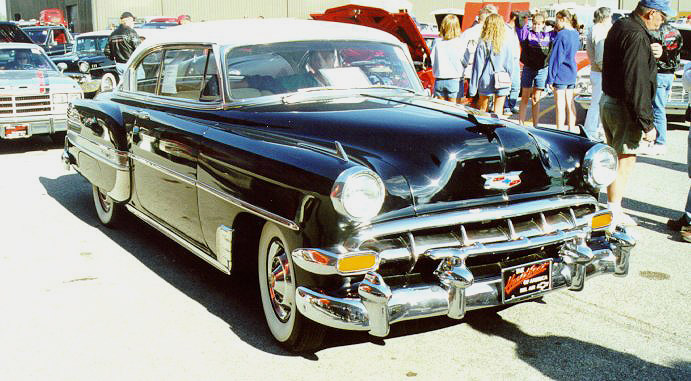
 1954 Bel Air 2dr Hardtop
 1953 Bel Air dash
New for 1953 were three distinct series for Chevy
buyers to choose from: the Special 150's, followed by the Deluxe 210,
and a full selection of Bel Airs. Marketed for all segments of the
low-price field, the base "Special 150" series was utilitarian in
every way, offering no real side trim, and the minimum of interior
appointments. Body styles included a Special Business Coupe, Club
Coupe, two and four door sedans, plus a four door "Handyman" station
wagon.
The most popular line (based on sales figures) for the 1953 Chevrolet
was the "Deluxe 210" series. Distinguished by a simple stainless steel
body-side trim spear and bright rear stone-guard panels on the leading
edge of the rear quarters, one could order a Deluxe Club Coupe, two or
four door sedans, plus a pillarless Sport Coupe and at the start of
the year, even a convertible. Also assigned to the 210 series were a
pair of four-door station wagons, the Deluxe Handyman, and the
sparkling new Townsman. Featuring top-line trim and features was the
Bel Air series. Prior to 1953, Bel Air had been the name given only to
the hardtop coupes. This year with its distinctive side trim,
including a color spear on the rear quarter panels, and more luxurious
interior appointments, the Bel Air included two and four door sedans,
a two-door hardtop "Sport Coupe", and of course, a convertible. Some
of the more unique options available on Chevys in this time period
included the Autoronic Eye which was available on all GM passenger
cars for automatic headlight dimming, full wheel covers, a special
"Jet-bird" hood ornament. Also included were things we consider
mandatory today such as radio, heater, defroster, turn signals and
back-up lights.
In 1954 there were a number of minor changes both in
power, styling, and model line-up for Chevrolet. Under the hood the
Blue-Flame six was tweaked and the 235.5 cubic inches now had 115
horsepower in standard base form, while models equipped with
Power-Glide made a rousing 125 horsepower. For the first time, a whole
list of convenience accessories were available. They included power
windows, power seats, and most helpful, power brakes.
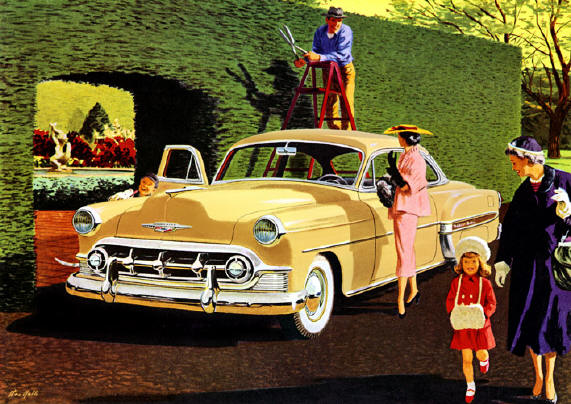 1953 factory artwork.
The broad color palate grew for 1954, with a total of fourteen single
colors and thirteen two-tone selections. Interior selections were
numerous, and color keyed in many cases to the exterior of the cars.
Available on certain models of the Deluxe 210 series was the all-vinyl
Delray interior trim in several color combinations. The outside of the
1954 models looked very similar to the previous edition. The grille
now sported five vertical fins rather than three, and the turn
signal/parking lights had become oval in shape housed in fender
wrapping chrome bezels. From the rear, the 1954 Chevrolet's taillight
became a one-piece lens at the top, while the lower half was reserved
for the optional back-up lights.
The 1954 Chevrolet model line-up was similar to 1953. In the Special
150 series, the Business Coupe was replaced with the new Utility
Sedan, a two door model with only a front seat and rated as a
three-passenger car. Two and four door six-passenger sedans returned
along with the Special Handyman four-door station wagon. The Deluxe
210 series model selection was cut back to the two-door sedans,
four-door sedans, and Club Coupe. Offered in the middle of that model
year was the Delray trim package. Rounding out the series was the
Deluxe Handyman four-door station wagon.
For Bel Air buyers there was one more model to choose from. Both two
and four door sedans reappeared as the mainstay of the series, while
the Sport Coupe hardtop and convertible were the cars everyone dreamed
of owning. The Townsman four-door station wagon that had been in the
210 series for 1953, graduated up to the Bel Air line in 1954,
receiving special side trim to go along with its faux-wood panel
finish. In 1953, Chevrolet retained its sale leadership over Ford by
producing a total of 1,356,413 units. For 1954, Chevrolet slipped just
slightly behind Ford in the model year sales and production race by
less that twenty thousand cars. To make up this difference, when the
new 1955 models were introduced late in 1954, production was stepped
up with dealers becoming overloaded just so Chevy could capture the
calendar year production crown.
While the 1953 and 1954 Chevrolets by themselves are
quite attractive to Chevrolet buyers, there are a couple of extra
items to look for that can add to their value.1953 saw the
introduction of power steering for Chevrolet. Relatively few cars came
equipped with this convenience option and today a complete working
system can add upwards of $1,000 to the value of any model. The
Power-Glide automatic transmission was a very reliable unit, but the
premium value for this factory extra is negligible in today's
collector market.
Helping to boost the value of these cars are the typical factory trim
and accessory items of the era. Fender skirts were technically an
option, even on the Bel Air models. For closed cars, windshield shades
are always a plus, whether factory original or the popular Fulton
aftermarket units. Two-tone paint schemes were just starting to gain
popularity in 1953 and 1954, and Chevrolet used a couple of different
varieties for their cars. The Deluxe 210 series and Special 150s both
were limited to the roof being painted in a contrasting color, however
on the 150s this is a very rare option from the factory.
For Bel Air, both years offered two-tone schemes that found the roof
and the rear quarter area surrounded by stainless trim painted in the
contrasting color. Unlike some car makers of the time, Chevrolet
prohibited the reversal on many of their two-tone schemes, if not for
ease of assembly, then just for the aesthetics of appearance. A large
number of 1953 and 1954 Chevrolets have come under the knife of the
customizer and street rodder as they lend themselves well to being
modified. However, purists are really starting to pay attention to
these cars for both their historical importance and their attractive
lines.
One trick of the early Chevrolet builders of this era is to place a
small block V8 engine under the hood. But of course, this is not
something the factory did when they were new. (A few prototype 1955
Chevrolets with V8s were skinned in modified 1954 Chevy trim to
disguise them, but these never made it into the hands of the public.)
As with any car, there are the typical items to be aware of. Look for
mismatched trim alignment. Often if a door or fender have been
replaced due to rust-out or an accident, the trim from panel to panel
might not match up quite right. Check closely for mis-matched or
unmasked paint to reveal where a light blue door was repainted and
placed on a red car.
One thing about these cars is that they seemed to hold up to rust and
corrosion quite a bit better than many of their competitors. Using
body-on-frame construction, typical areas prone to road rot should be
closely inspected. Most notable are the floor panels (especially on
the convertible), and the trunk area, with extra detail given to the
spare tire well on the passenger cars.
Prices on the 1953 and 1954 Chevrolets are almost
identical, and if you think about it, except for a few trim parts,
they are basically the same car. Personal taste may dictate a
preference based on parking or tail lights, but that is up to the
buyer. Currently, Bel Air convertibles have been running between
$11,000 for complete and presentable models up to $22,000+ for
restored examples. Sedans are much less expensive. The business coupes
for 1953 and Utility Sedans for 1954 pick up a little more interest
due to their rarity and unusual seating arrangements. Prices for the
base 150 and 210 sedans have been running between $3,000 for decent
complete and unmolested examples, up towards $6,500 and above for
prime specimens.
Pricing for these cars appears fairly stable. They are great for the
collector or Chevrolet fan who likes to be noticed but is content to cruise along in a leisurely manner. Values will always remain far
behind the 1955 to 1957 models due to the lack of a V8 engine and the iconic status of the later models. Which make these a bargain today.
2019 update: Values ran up during the 2000's until the crash, where they gave up about half their gains. Since then there has been a slight upward trend, but lagging far behind the hotter segments of the market.
Figure mid twenties for a nice Bel Air hardtop and up to $40,000 for a convertible. Exceptional examples can bring more, but like many cars from
this era, the restorations were performed years ago and are begining to lose their crispness. Many are being turned into customs, with V8's, modern performance enhancements and
creature comforts added. On a budget? A #3 sedan is $6-7,000 and delivers a lot for short money.
(C) Copyright 2005-2019 VMR International, Inc. All rights reserved. This article first appeared in the November 1999 issue of Collector Car & Truck Market Guide.
 |
 |
 |
 |
| |
 |


