 Values
Reference
Profiles
Exotics
Order
MENU
Values
Reference
Profiles
Exotics
Order
MENU

Anniversaries are a common occurrence for a marque as old as Mercedes-Benz, so 2003 shouldn't be forgotten as the 50th Anniversary of the mighty SL. The original 300-SL concept was initially intended only for the race track, where it posted numerous storied victories. It wasn't until a year later that a street version of the race car would be released, and then it would come out as a rather spectacular coupe with "gullwing" style doors. After the tragedy of the Grand Prix at Le Mans in 1955 when over 80 spectators were killed after an SL race car went out of control, Mercedes-Benz withdrew from factory-sponsored motorsports, ending a long history of competition success.
| Plus | Minus |
|
Still affordable |
Many were neglected when they became just used cars Service/Maintenance costs above average |
At the same time, a new era was launched with the SL ("Sport Light") series. Although the new 300-SL was expensive by nearly everyone's standards, a more affordable was introduced shortly thereafter with the 190-SL in late 1955. This one was a convertible model, referred to in advertising as the "roadster". For those who had a bigger checkbook, 1958 saw the 300-SL Gullwing coupe replaced by a convertible, although it is more commonly referred to as a roadster.
Through the rest of the 1950s and into the early 1960s, Mercedes-Benz SL's found a dedicated following. In 1964, a whole new family was introduced, boxier in design but with a bigger and improved powerplant over the previous 190, and considerably less expensive than the powerful 300. During its run, the SL grew in popularity, as ever more sports car fans flocked to their Mercedes dealers for 230, 250, and eventually 280-SL roadsters.
The New SL
As the 1970's dawned, the next generation of the SL legacy went on sale. For the European markets, this new design was marketed as the 350-SL featuring a 3.5 liter V8 engine. In keeping with the Mercedes tradition of the model number indicating the engine size, this made perfect sense. However, in America, the 1972 350-SL was actually equipped with a 4.5 liter V8 engine, rated at 190 horses in order to compensate for power loss due to new US emission rules. For the 1973 model year, the 4.5 liter equipped roadster was given the proper nomenclature and the 450-SL was born.
Known among Mercedes buffs as the type "W107", it featured a lower, wider, and rounder body than the previous edition. Sitting on a 96.9" wheelbase, these sharp-looking cars measured 172.5" from bumper to bumper. Although designated with the SL or "Sport Light", the 107 was anything but light and arguably not that sporty. In fact, it is more accurately described as a Grand Tourer with a top that goes down. Speaking of GTs, a true GT version with a stretched 2+2 hardtop body style was also marketed. Designated the SLC, it featured seating for four enclosed in a stylish pillarless body.
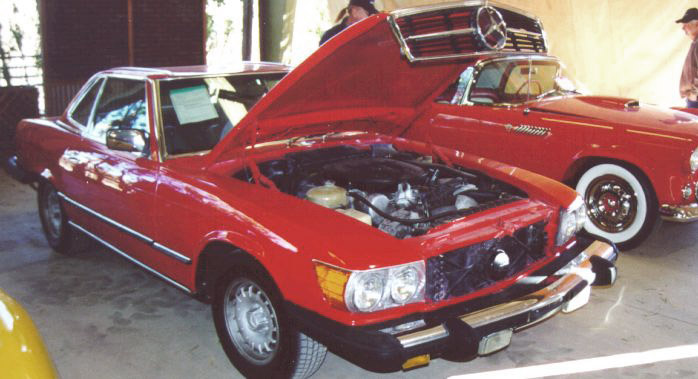
 A '79 SL with the unfortunate bumper design. This one sports aftermarket chrome flares, a popular add-on.
 Interior is efficient and superbly stitched together.
 The hardtop coupe is a fine tourer. This is an early Euro 350SLC, not sold here. (M-B photo)
Exclusive to the N. American market after 1973 were the huge impact absorbing rubber bumpers on both ends of the car, appendages that are unflattering to the design, but mandated by the Federal Government. It seems a bit odd, though, that a company that possessed such vaunted engineering skills couldn't come up with a better looking system (GM was the leader here) than they did.
Also unique to U.S. specification SL's was a quad headlight system using familiar round sealed-beams, replacing the single custom fit rectangular units issued for the rest of the world, which were not DOT approved is the US.
Featuring all-steel construction and weighing in at 3,750 pounds, the 450SL roadster was heavy, even overweight to many. Nevertheless, this sleek little car became a hit right away, despite a base price of around $11,000. A popular option was the detachable hardtop, also of steel construction, which could be stored in a garage during the warmer summer months. To this day, a number of U.S. Mercedes-Benz dealers actually promote their storage of SL roofs as a courtesy to their customers. This extra top added a few hundred dollars to the price tag, which didn't matter to most buyers as nearly every SL sold in the USA came so equipped.
Towards the end of 1973, America was hit by the first Arab oil embargo, and Gas prices skyrocketed from an average of 30 cents a gallon to well above the 70 cent mark. For most big luxury cars, this was a death sentence, but for buyers of the luxury SL, which cost twice as much as the average luxury sedan and about 25% more than a Cadillac Eldorado convertible, it was a minor inconvenience.
Sales stayed strong with over 6,500 units sold in the USA during the 1973 model year as the base price jumped to $13,941. The following year, when the embargo was finally lifted but gas prices remained at double their previous levels, the number of 450-SLs sold dropped to just under the 6,000 mark as the SL's sticker jumped again, now at $15,540. For 1975, this trend of rising prices continued to spiral upwards, shooting to $17,797, or a 67.6% increase in just three years. Due largley to strengthening German currency (DM), by 1978 the opening cost for this popular Mercedes sports car was up to $26,777, topping out at a whopping $31,845 in its final year, nearly three times the price from just eight years earlier.
All 450-SL/SLCs sold in America were equipped with a ZF provided three-speed automatic transmission. Popular accessories included special cast aluminum wheels and air conditioning. Indeed, we've never seen a U.S. spec SL without air conditioning.
During its run from 1972 to 1979 a total of 82,332 350/450 SLs were produced for world-wide consumption with over 50% of those arriving in the USA. The SLC saw approximately 14,000 units exported to these shores.
If you are considering one of these German beauties there are a number of things to look for. Inspect the engine bay for excessive leakage or fresh valve cover gaskets--it could be a clue to drivetrain woes. While the ZF automatic used in the SL is dependable (though somewhat sloppy), a previous rebuild on the cheap or incorrect can be a very pricey problem down the road.
Also make sure to inspect for body condition behind the bodyside cladding. This sometimes conceals rot and rust and minor damage. Other rust prone areas include around the headlights and in the trunk. Inquire about the hardtop should it not be visible and be sure to check the condition and integrity of the soft top as a proper replacement is not cheap. On more than one occasion we have seen SLs trade hands only to have the new owner find out that the top was either gone or in tattered condition. On the SLC, examine the sunroof (if so equipped) for leaks and signs of corrosion.
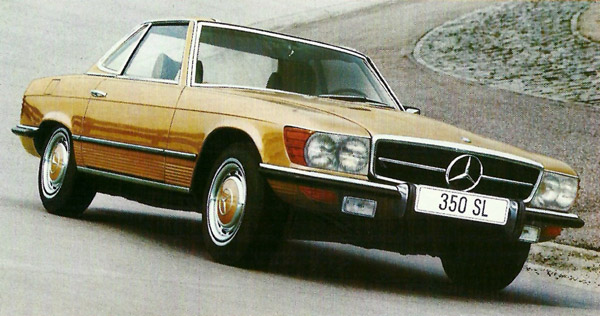 An early US SL without the later bumpers.
As to which one to buy, the '79 and '80 models are the most robust of the series, while the pre-bumper cars are (by far) the best looking and lack much of the later emission equipment, including a catalytic converter. The '74-76 versions are the least desirable.
Most of those who own one of these popular convertibles do not treat them as cherished show cars for concours style exhibitions. Most current 450-SL/SLC owners drive their cars thousands of miles each year. Many are still used for daily transportation.
As one of the most comfortable 2-seat convertibles ever produced, the SL delivers immense driving satisfaction. The seats are big and comfortable, the driving position is perfect and the dash layout and ergonomics are pretty good even for today. The engine is smooth and quiet, although it could use more horsepower.
Be aware that ownership of a 350/450-SL will most likely involve relatively heavy maintenance costs. Although these are solid and durable cars, they're also European luxury cars, and simple parts such as wiring, spark plugs and electrical items are usually priced at a healthy premium over your average make. For instance, an complete engine rebuild could cost you over $10,000! We would also recommend that you have any mechanical work done by a trained or experienced mechanic in this marque. This isn't a Chevy.
Fortunately, parts are plentiful. There is a large aftermarket industry set up around the Mercedes-Benz marque and they can usually provide you with any mechanical or trim piece you may need. For a price, of course. Even Mercedes-Benz corporate has got in on the act with their Classic Center.
It has been nearly a quarter-century since these were produced, and prices for these cars have remained remarkably stable over the past several years. They have not participated in the recent run up of the collector car market. This could be due to a wariness to owning one due to its upkeep costs or it could be due to the fact that the same body style (in convertible form) was produced as the 380SL and the 560SL up until the late eighties.
Reasonable and perfectly serviceable examples can still be found for under $10,000 and $15,000 will get you a really good one. 2019 Update: Those numbers are still largely true, though the best investment quality examples are $30,000+ with a few select examples exceeding $50,000. Due to its complexity and high parts costs, we recommend that you buy the nicest one you can afford. Those "bargain" SL's you see under $5,000 will most likely end up costing you plenty more than that to get them right. (Current values here): Mercedes-Benz)
Valuewise, It looks like the earlier cars in #1 and #2 condition bring the most, and they're likely best poised for the future. Late production, 1979-80 are next. After that, for all practical matters it seems to be a tossup, with condition being the most important factor. Of course, the most desirable versions of these models didn't come here at all -- they're world market cars without the bumpers and emissions.
It remains to be seen if these models are merely lagging the market or if they will be stuck at current levels. Our guess is the latter, at least for the next few years. There are just too many of them out there relative to demand as a collector car.
(C) Copyright 2003- VMR International, Inc. All rights reserved. This article first appeared in the September 2003 issue of Collector Car & Truck Market Guide.
 |
 |
 |
 |
| |
 |


