 Values
Reference
Profiles
Exotics
Order
MENU
Values
Reference
Profiles
Exotics
Order
MENU
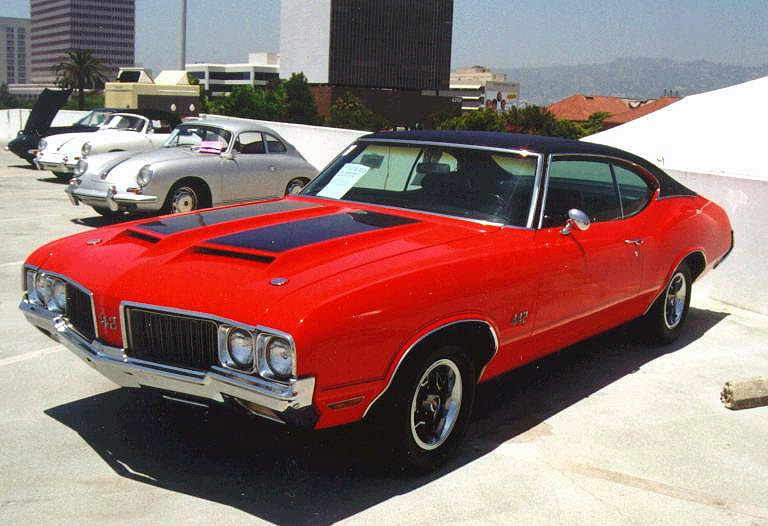
In the mid-1960's, nearly every American automaker was jumping into one of the hottest market segments, the musclecar. Oldsmobile was an early player. A mid-1964 model year offering from the mid-size F-85/Cutlass line was a potent 4-4-2 package. Drawing on a reputation of performance dating back to the introduction of the "Rocket V8" in 1949, this new package would prove to be a great success. Taking the basic muscle car ingredients, a mid-size vehicle powered by a high horsepower engine, some trick heavy-duty suspension pieces, and a well engineered four-speed transmission, Oldsmobile brewed up a winning combination. Unfortunately, it was poorly promoted compared to Pontiac's GTO, lacked the big block power of the GTO and got lost in the phenomenon that was Mustang.
| Plus | Minus |
|
All the GM mid-size attributes |
Lower prices up front mean lower prices at sale time Watch those vinyl roofs! |
To produce the 4-4-2, Olds started with either the Cutlass or F-85 hardtop coupe, which had grown from a compact in 1961 to a mid-size class vehicle by 1964. The model designation 4-4-2 represented the use of a four-barrel Rochester "4GC" carburetor, a close-ratio four-speed transmission, and dual exhaust. This 4-4-2 package also included a beefed up suspension that borrowed parts from Oldsmobile's police car program, and a modicum of special trim ornamentation. Under the hood a big V-8, option code BO-9, gave buyers 330 cubic inches serving up a healthy 310 horses.
Oldsmobile brought back the 4-4-2 package in 1965, and it became one of the most popular options available that season. Adhering to new GM restrictions on high horsepower cars, the Olds team took their engine to the 400 cubic inch limits imposed by the bosses of the corporation, but tweaked that mill to create a very healthy 345 hp in its basic "W-29" variation. Sales were good, and GM execs were turning a blind eye to these practices and allowing the individual divisions to come up with cars that sold.
1966 saw new highs in the performance and convenience categories. Tired of getting beat at the track, the engineers at Oldsmobile did some fine-tuning to the 400 cid mill, and the base offering was now rated at 350 horses. An optional L-69 package pushed this to 360 horses, which won wide acclaim by the motoring press of the day. Also new for 1966 was the choice of an automatic transmission for those who would rather not shift themselves.
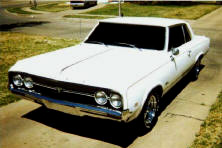 The '64 started with a stout 310hp 330ci small block V8. It handled better than a GTO.
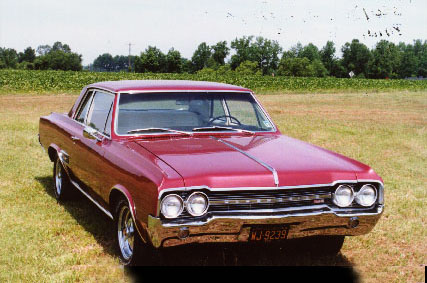 The '65 got minor styling revisions and big block power.
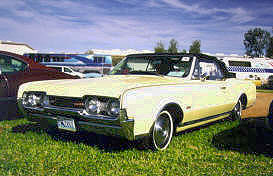 The '66 and '67 models launched the 442 into the big leagues with the W30 option. This is a Base '67.
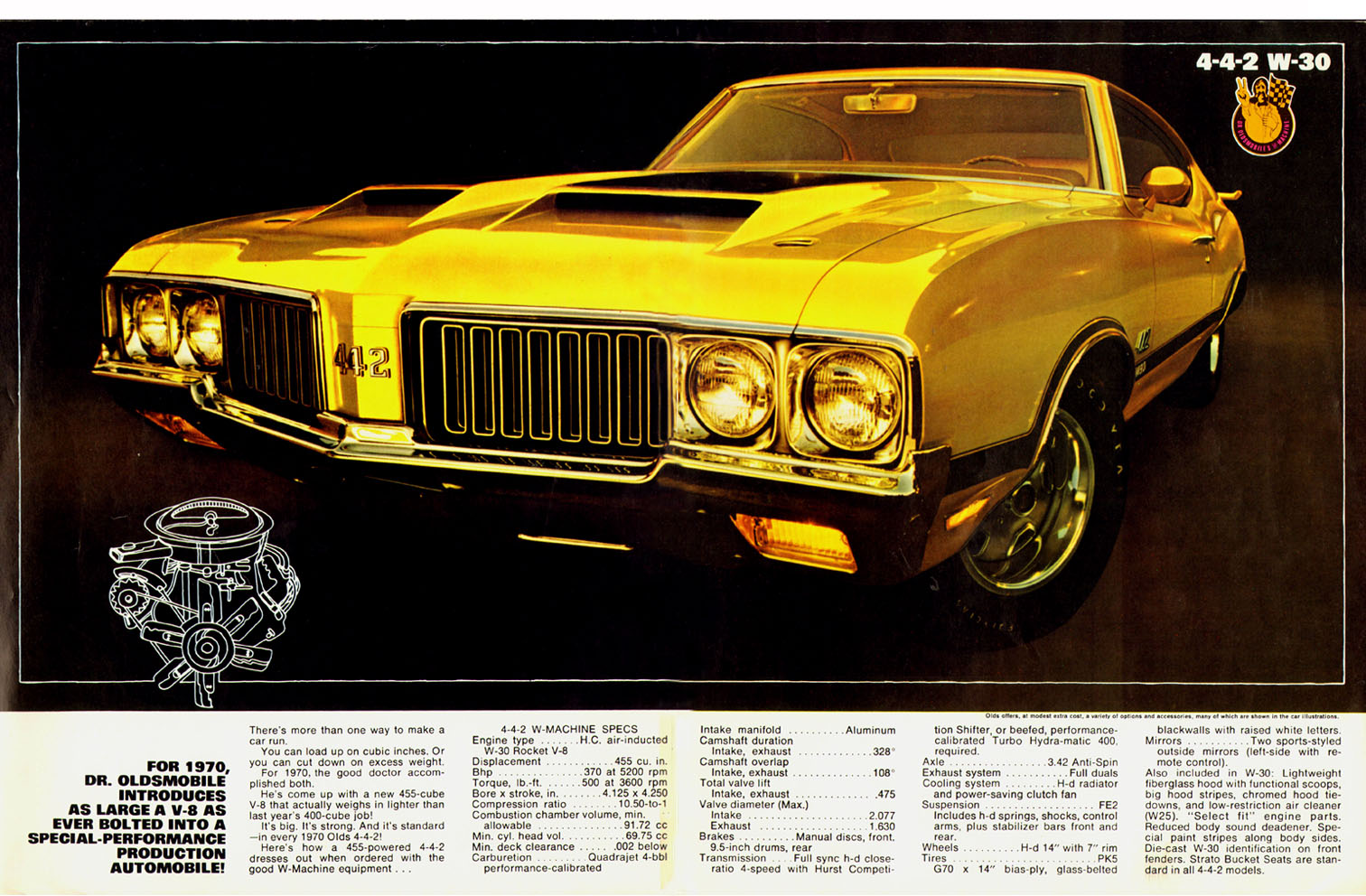
Then in mid-1966, all hell broke loose with the introduction of the fabled W-30 package. Not meant for the general public, the W-30 was a factory competition option. The W-30 was fitted with a an air induction hood, a radical high-lift camshaft, a beefed-up suspension, deletion of luxury items such as sound deadening and insulation. The battery was even mounted in the trunk. On top of this, heavy duty brakes, a scatter shield for the clutch and lightweight body parts all around helped make the W-30 the ultimate performance Oldsmobile. So potent was this engine that Oldsmobile never released the horsepower rating, which has been estimated by some to run well over the 450 mark in prime tune.
1967 saw slightly revised Cutlass styling, and the 4-4-2 continued to be one of the most popular option packages. Basic engine offerings remained the same as in 1966, except for the W-30 performance edition lost its triple carbs in favor of a 4bbl. It was still a potent machine.
For 1968 the 4-4-2 was marketed as a separate series rather than just an option package for the Cutlass. It was, of course, still based on the Cutlass, and shared the 2-door Cutlass' shorter wheelbase. The W-30 option was back, and still potent, but it had become a more respectable street car, suitable for the the general public. It was still a desirable option, now sporting a blueprinted 400 cid V8, but was tamed down to 360 hp. Now non-W-30 4-4-2s could be equipped with some of the dress-up items of that package, such as the special hood, styled steel wheels, and exterior stripe packages. Also, for the first time the 4-4-2 was offered in three distinct body styles, two-door coupe, two-door hardtop, and convertible.
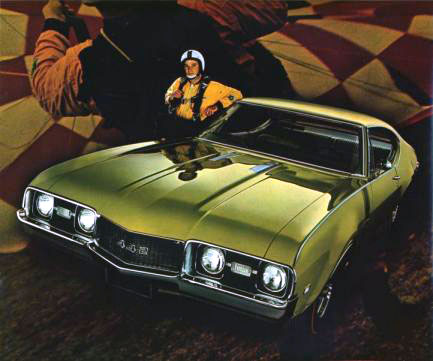
Adding to the performance reputation that Oldsmobile was building with the 4-4-2 was the alliance formed in late 1967 with the Hurst Corporation. Long famous for providing the best shifting kits in industry, George Hurst had come to Jack "Doc" Watson at Oldsmobile with plans for a specially prepared 4-4-2, intended for Hurst's personal use. Through this relationship, the H/O 4-4-2 was born, and another chapter in performance history was written. Look for that story in a future profile dedicated to that special model.
1969 saw few changes to the 4-4-2 program, with the 400ci W30 V8 rated at 360hp, 10 above the base 400. A mild facelift smoothed out the front end, and a handful of mandated safety items changed a few minor details. As with most musclecars by now, the automatic transmission was far out-selling models equipped with the four-speed. Diluting the model's looks somewhat, 4-4-2 inspired dress-up kits and decal packages were finding their way onto other Cutlass models, including the W-25 performance hood option.
As the 1970's dawned, Olds dropped the 400; replacing it with a monster 455 cid V8. This "W-32" engine arrived with a 365 horsepower rating. The performance W-30 package was back, too, tweaked to give out five extra horses and even more torque. Sales continued to be strong, but dark clouds were forming on the horizon.
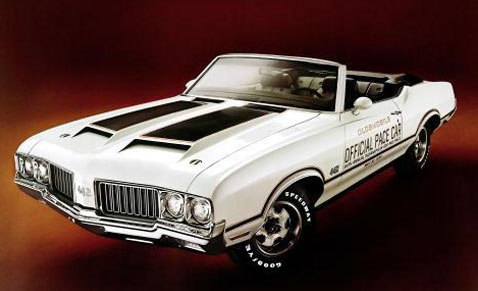 The 442 paced the Indy 500 in '70 and again in '72. This is the '70 version.
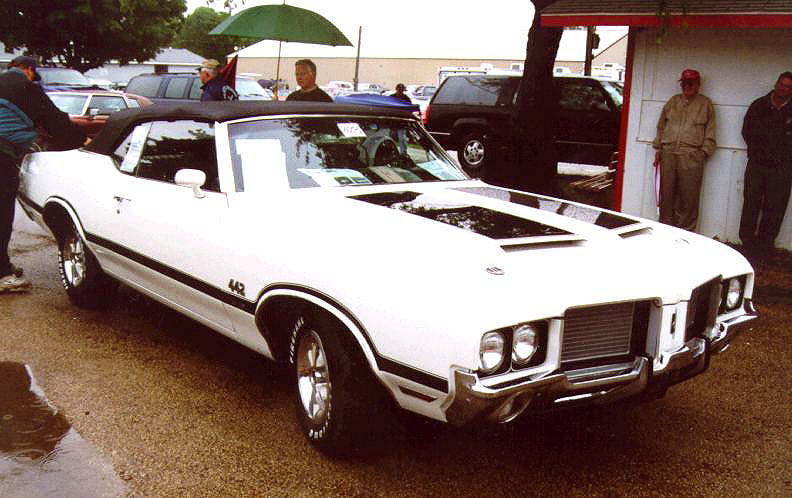 A rare '72 W30 convertible at auction.
 Yes, that's Linda taking a parade lap in 1972, risking life and limb for her fans!
Starting with the 1971 models, government clean air regulations, coupled with soaring insurance rates, began to affect power output and the muscle car industry as a whole. The standard V-8 in the 4-4-2 was detuned that year to 340 horses, and even the W-30 was taken down a notch to 350. The slow selling pillared coupe body style was deleted from the 4-4-2 line-up, leaving just the convertible and hardtop. It was also the final season that the 4-4-2 would be marketed as a separate series, though the option package was returned to the Cutlass series in 1972. After that, this once mighty performer became more of a sporty appearance package.
When the muscle-car collector market exploded in the late 1980s, many over-looked the Olds 4-4-2 in the rush to the more popular Chevelles and GTOs. What this did was to allow those on a budget to indulge in the hobby, but at a lesser cost than those attracted to the more popular models. The limited production models, however, have always found favor with collectors. Early 4-4-2 packages have been sought after for quite some time, even though they don't bring the money the later models command. The Hurst editions were also recognized as collectible almost from the start of the muscle car craze. And of course, W-30 packages have always carried a premium. In 1970 it was an Oldsmobile 4-4-2 H/O convertible that paced the field at Indianapolis, an honor that was repeated in 1972. The Division capitalized on these appointments and special Pace-Car editions for both years were produced, both of which also drew early collector interest.
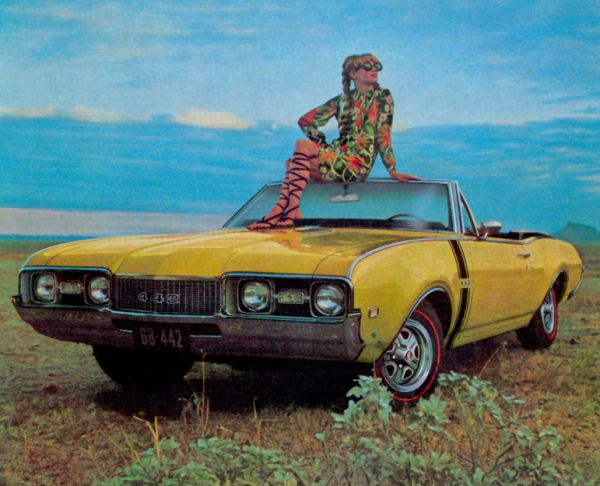
Numbers Check
While the 1970-72 models have always been popular, in today's collector market the earlier 4-4-2 has shed some of it's anonymity and taken its place next to the more popular later versions. There are a number of things to watch for on the earlier cars. Beware of ID numbers, both on the VIN and the under-hood build plate. From 1964 to 1967, the 4-4-2s were considered an option package for the F-85 Cutlass, so the VIN prefix will not show this package. This has spawned many a fake, so you'll need to do a little legwork to make sure you are in fact buying what is represented. Under the hood, the engine was unique, so block numbers need to be referenced. Obviously, original paperwork such as the window price sticker or a certified build sheet would help in verifying the authenticity of these cars. And often GM's historical division can help verify a particular vehicle.
Starting in 1968, and running to 1971, the VIN-prefix for all 4-4-2s started with "344.." For post- 1972 models, the 4-4-2 models were again incorporated into the Cutlass series, and this is where original documentation is once again most helpful in verifying the pedigree of these performers.
Muscle cars today are seeing strong activity. Authentic 4-4-2 convertibles command a very strong price, topping out in the mid-to-upper $20,000 range for nice, but not perfect, street versions. 2019 Update: make that $35-$40,000 today, with air conditioning highly desirable. Coupes and hardtops generally bring a bit less, with one exception. Performance models with the W-30 option can command at least a 25% percent premium over standard 4-4-2s. The rare '66 W30 can bring double -- or more for an example that's "just right".
Ever since General Motors announced the planned departure from the marketplace of the Oldsmobile brand, there has been a lot of talk that the prices of all cars carrying this badge will escalate in price. We find this difficult to follow. With over 100 years of production, combined with the millions of cars produced with the Olds name, it seems that there will be plenty of these cars available for those seeking to own a piece of history. In fact, now that Oldsmobile is joining the "orphan" family, an argument can be made that values will decline relative to still active marques. However, the 4-4-2 in all it's guises, from the hairy early W-30 to the luxo-performance of the early 70's, is an attractive package, and we think that collector interest will parallel similar muscle cars of the period.
(C) Copyright 2001- VMR International, Inc. All rights reserved. This article first appeared in the November 2001 issue of Collector Car & Truck Market Guide.
 |
 |
 |
 |
| |
 |


