 Values
Reference
Profiles
Exotics
Order
MENU
Values
Reference
Profiles
Exotics
Order
MENU

Stylish, sporty, and reliable, first-generation Celicas offer a lot of smiles per mile. They're practical, too--and with good gas mileage (22-26mpg), they make a lot of sense as both an everyday driver and weekend cruiser.
| Plus | Minus |
|
Devoted following |
Rust Getting pricey Some trim parts can be tough to locate |
Celicas hit these shores for the 1971 model year. Powered by a 1.9L SOHC 4-cylinder engine making 108hp backed by a 4-speed manual transmission, performance was just spirited enough to make it fun. Outside, the Celica presents generally pleasing lines, though at certain angles things look just a tad frumpy. There are a lot of badges, logos and stripes, but somehow they manage to come off as period cool. We love the little dragon (no its not a swan) on the grille!
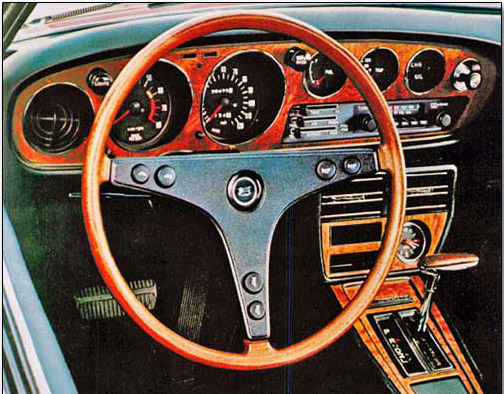
Inside is extremely well executed, especially considering the price point these came in when new (initially about $2600--well equipped). The dash is particularly impressive (even with the plastic wood) and sports a tachometer and full gauges. 1973 saw the end of the clean, one piece taillights in favor of three lens units. A GT model joined the lineup for 1974, and got a tighter suspension, a 5-speed manual transmission and minor trim differences. The biggest change occurred in 1976, when it was stretched, widened and got a revised dash. A new liftback body was added to the line, and sales soared.
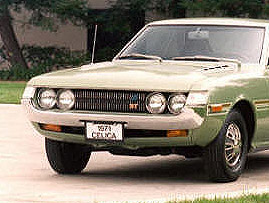 The attractive, almost delicate, front end of the '71.
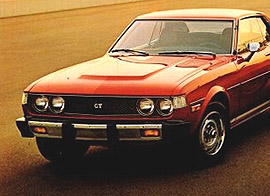 Bumper regulations forced some changes for '75-'77 models (this is a '76). While Toyota did a decent job with them, we like the earlier cars far better.
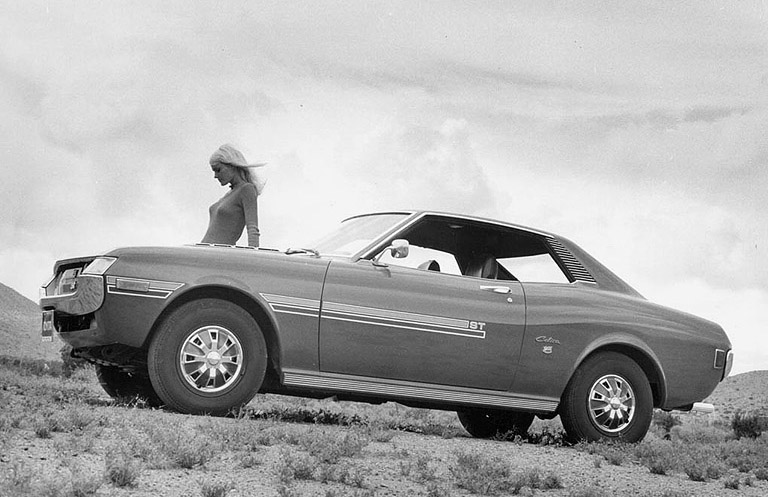
 Many called the Celica the "Japanese Mustang". You can see why!
The Celica lives up to Toyota's reputation, and in fact, helped build it! It's well put together and has no significant mechanical issues. That doesn't mean they were trouble fee however, with a tendency to fry valves an early problem. According to Rick Dormoi at Toyhead Auto Restoration Services in Philadelphia - ToyHead Auto - the biggest issue is rust. Like all Japanese cars of the period, Celicas used thin, recycled steel, said Rick, and it deteriorated quickly when exposed to the elements. Get the most rust-free example you can find, as good body parts are becoming difficult to locate. In fact, finding any part at all can be a challenge. Finding and paying extra for a complete, running, rust free example (or close) is the smart play and will cause far fewer headaches in the long run, especially later examples.
On the mechanical side, a simple MacPherson strut/coil spring live rear axle suspension means few problems and low maintenance. The standard front disc/rear drum brakes are adequate. The engine bay received constant attention. A slight increase in displacement and a reworked head (to combat the aforementioned valve issue) was first, then a new, much improved 2.2L mill greeted buyers for 1975. The U.S. never got the performance versions of any of these engines that the home market enjoyed, but we've seen some extremely well executed upgrades here, along with the appropriate suspension and brake mods.
Talk about bang for the buck. For less than $5,000 (that was 2006, today you're looking at a bit more) you get a nice collector car that will give you years of cheap reliable service, only go up in value, and it looks great to boot. All Celicas were very well equipped from the factory, and the only option that might bump up value a bit is integrated factory (dealer) air, though right now the market is not showing any consistent premium for it. Manual transmission cars are an easier sell than automatics (added to the option list in 1973) and carry about a 20% value penalty compared to a manual.
Over 500,000 Celicas came to these shores during its production run, yet relatively few remain today. There are several plausible reasons for this. They were very affordable when new, and many were likely purchased by young men who weren't particularly kind to them. This held true for successive owners and maintenance likely became a "needs it now" proposition. This was the case, of course for American pony cars, too, but recognition came to that group way before most thought a Celica was worth saving. But probably rust was the biggest killer. As bad as many cars were during this peiriod, Japanese cars were the worst. Any of them living in the salt belt that were not rustproofed by Ziebart or the like did not last long. Even those that were succumbed to the tin worn relatively quickly. Many have been modified, too, and when done right can bring prices above a strictly stock version.
What's best to buy? Despite not having some of the later refinements, (which can be rectified fairly easily), we like the 71-74 cars best (they bring the most dollars, too), then the 76 and 77 Liftbacks. the '74 GT with its 5-speed and upgrades is particularly attractive. The early cars are just plain neat, while the later cars lost some of their whimsical character. After the '74 model year they got big, ugly bumpers that are so typical of the period.
While not really quantifiable, the Celica epitomizes Japan's automotive transition from fringe player to rising star, lending it a bit of historical significance. With favorable demographics increasing the interest in these cars every year, look for at least a 20% gain over the next 24 months. Celicas rarely show up at auction, so you'll likely be scouring online classifieds. The $10,000+ Celica is not far off. (Update 2015: since this article was first written in 2006, Celicas have continued to steadily appreciate. The $10,000 Celica is not uncommon now, and $15,000 is not unheard of. Update#2, 2019: Values have not moved much since the last update for a nice, #2 (stock) example, and we've seen the very best advertised at $40,000. We think that's a bit rich, but $25,000 may be a realistic these days. The liftback seems to be most popular right now, with values above the '76-'77 coupe and equalling the earlier cars.)
(C) Copyright 2006- VMR International, Inc. All rights reserved. This article first appeared in the December 2006 issue of Collector Car Market Review.
 |
 |
 |
 |
| |
 |


